
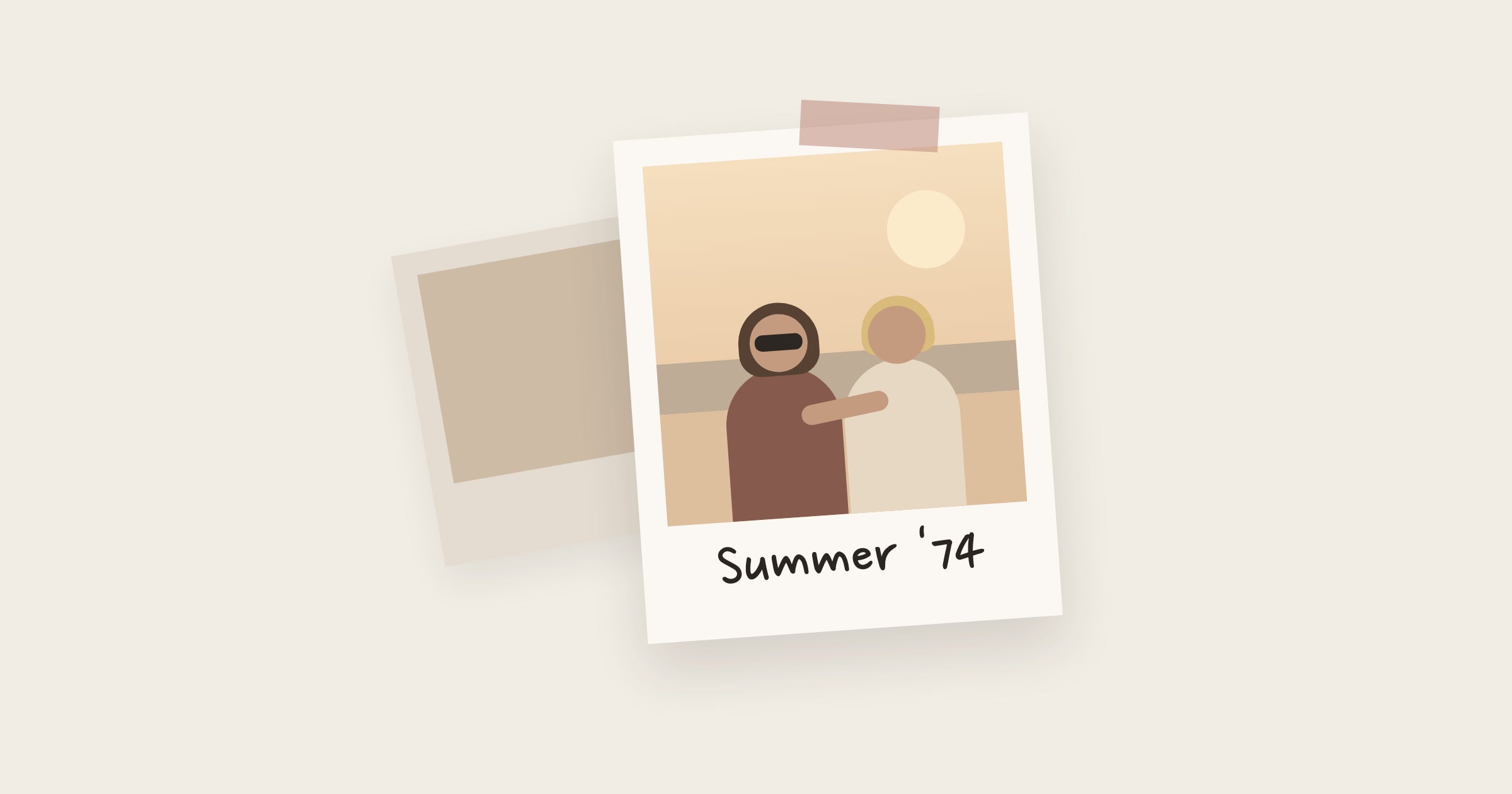
Somewhere in your parents' house there's a photo you were never meant to find that interesting.
It's usually in a shoebox, or at the back of an album nobody opens. Your mum, nineteen or so, squinting into the sun on a beach you don't recognise. The sunglasses are frankly too big. She's laughing at something somebody off-camera has said, and her arm is round a girl you've never heard of.
The first thing you notice is the hair. The second is that she looks like someone you'd want to be friends with, which is unsettling.
You turn it over. On the back, in biro: Summer '74. You ask who the other girl is, and your mum says “Oh, that's Jackie,” as if that settles it, and goes back to the crossword.
And that's that. Jackie goes back in the shoebox.
But here's the thing.
That photo is evidence. There was a whole person there before you arrived, with her own friends and plans and terrible sunglasses, and you've only ever met the version who came after.
You've known them your whole life. You haven't known them for theirs.
Opened in the middle
Think of your mum or dad's life as a book. A long one, with plenty of chapters. Some are funny, some are dull, and a few they'd rather you skipped.
You weren't there for the opening. You were handed the book somewhere in the middle, already open, and you started reading from there. Of course you did. It's the part with you in it.
Do the sums. If your mum had you at thirty, and your memories start at about five, then the first thirty-five years of her life happened with nobody in the audience but her. If she's seventy now, that's half the book.
Before you
You were there, but too young to remember
The part you've actually seen
Half a life, and most of us could summarise the first half in a sentence. She grew up in Leeds. She was a nurse for a bit. She met Dad at a wedding.
That's the blurb on the back cover.
The reruns
Part of the problem is that parents are hard to see clearly. You know them in one role, and it's a big one. A mum is the person who knows where the plasters are. A dad is the person who has opinions about the route. It takes real effort to picture either of them at twenty-two, broke, nervous before a date.
And the stories you do get are reruns. Every family has a few. The time the car broke down on the way to Wales. The holiday where it rained for a fortnight. You've heard them so often you could do the voices, and it's tempting to think that's the whole archive.
It isn't. The reruns are simply the stories that got asked for once, years ago, and stuck. When your dad starts on the Wales story again, he isn't boring you. He's offering you the one chapter anybody ever asked to hear.
Everything else is still in there. It just hasn't had its first question.
Two generations
Try a small experiment. Name your four grandparents. Most people can, give or take a surname.
Now name your eight great-grandparents.
Take your time.
Most of us stall at two or three. And these were people with first loves and bad jobs and favourite songs. Each of them was the centre of somebody's world. Two generations on, they've shrunk to a name on a certificate, if that.
Your mum
- Where she grew up
- Her first job
- How she met Dad
- Her favourite song
- What she's scared of
- How she takes her tea
Your grandma
- A town
- A job, roughly
- One story
Your great-grandma
- A first name
?
Nobody decides to forget. The details simply live in one person's head, and when nobody asks for them, they stay there.
Which means your mum or dad is the only person who can tell you the first half of their book. They may also be the last person who remembers anything about their own grandparents beyond a name.
Asking for the beginning
None of this needs a project. You don't need a family-tree subscription or a free weekend. You need a question that starts before you.
What did you want to be when you were fifteen?
Who was your best friend before you met Dad?
What did a Saturday look like when you were twenty?
Pick something real: an old photo, a ring she still wears, a place name that comes up at Christmas. Ask where it came from. Ask who else was there. Then listen for the moment she stops summarising and starts remembering, because that's where the real chapter begins.
Some parents will wave you off with “Oh, there's nothing to tell.” There always is. It has just never been asked for in that order. Others will surprise you with how quickly it comes, as if they'd been waiting.
And if your parents have already gone, the book isn't closed. The friend in that old photo might still be out there. So might an aunt, a cousin, or an old neighbour who remembers your dad at twenty-two. Chapters survive in other people too.
Who was your mum at twenty? What did your dad want before he wanted you? What's in the shoebox that nobody has ever asked about?
You were handed the book halfway through. It's worth asking for the beginning.
Glad I Got To Ask is 80 questions for the conversations you keep meaning to have, including plenty that start before you. Pull one out on your next visit and see where it goes.
See the cards