
How to Record Your Parents' Stories: A Simple Guide
By Glad I Got To Ask
Share
In short: To record your parents' stories you need a phone, a quiet room and about forty minutes. Pick one theme rather than a whole life, turn on airplane mode, prop the phone between you, ask open questions, and copy the recording somewhere safe the same day.
There's a good chance your phone is holding a voicemail from your mum that you'll never delete. Fourteen seconds long. She's ringing about nothing in particular: whether you got home all right, whether you still want that casserole dish back.
It's funny what ends up being kept. Not the big conversations, which nobody thought to record, but the throwaway ones that happened to land on a device.
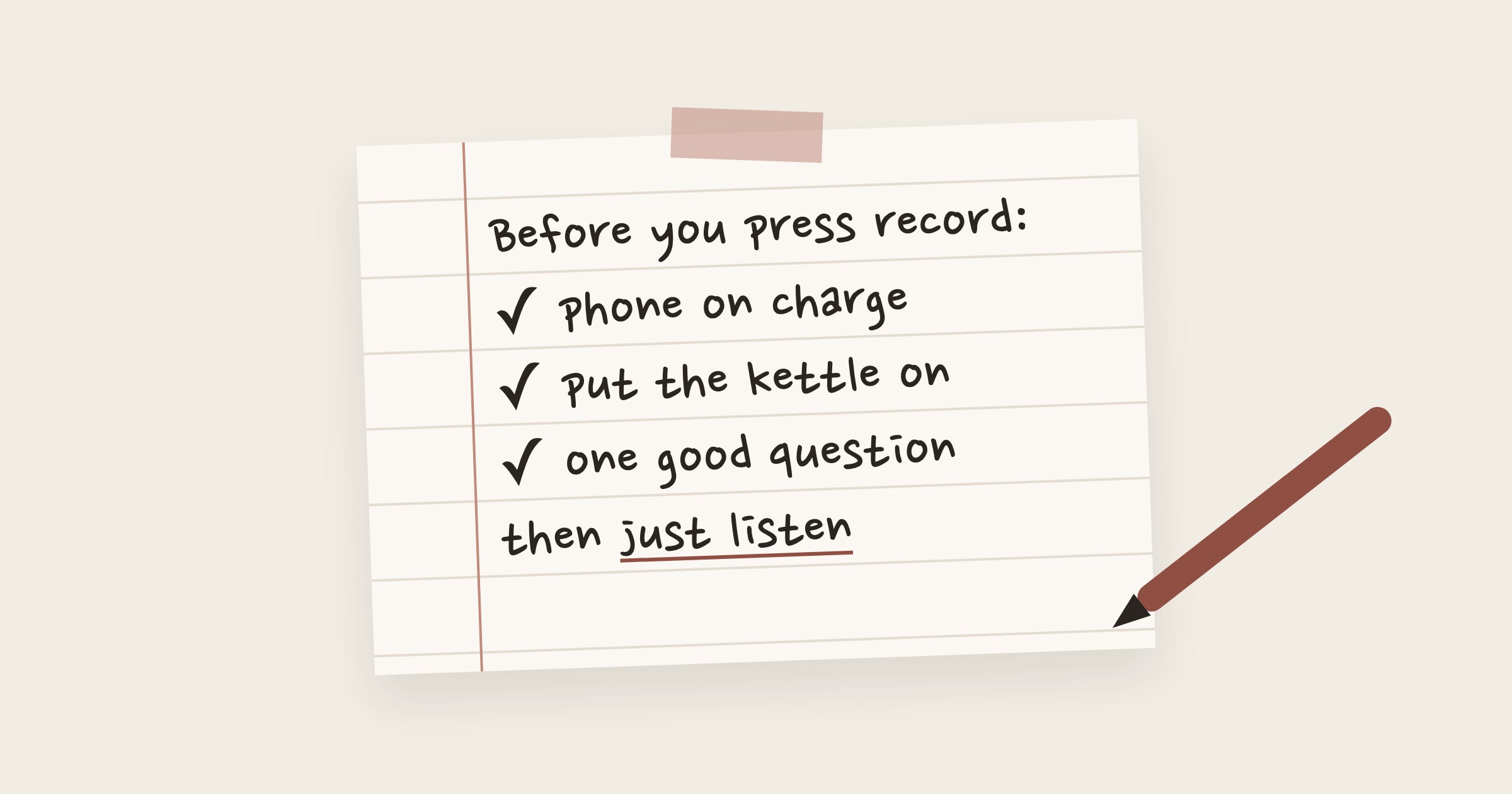
You can do better than luck. Recording your parents' stories doesn't need a studio or a professional. It needs a phone, a quiet room and about forty minutes. This guide covers the lot, from setting up to backing up, plus what to do if your dad would rather do anything than be "interviewed".
What you'll need
- A smartphone with its voice recorder app (or any recording app you like)
- A charger or battery pack
- Something to stand the phone on, like a mug, a pile of books or a cheap tripod
- A few questions written down
- Optional, but the best upgrade you can make: a clip-on microphone that plugs into your phone, which costs about the same as a takeaway
Before you start
Decide what it's for. A recording for the family archive is different from one you'll play at a big birthday. Knowing the purpose helps you pick the questions.
Pick a theme, not a whole life. One conversation can't cover eighty years, and trying to will leave you both exhausted. Choose a slice: their childhood, how they met, the year everything changed. You can always come back for more.
Ask your brothers and sisters what they'd want to hear. They'll remember stories you've forgotten, and they'll often remember the same story differently. Both versions are worth keeping.
Tell your parent what you're doing and why. Nobody likes being ambushed with a microphone. Explain that it's for the family, who'll hear it and where it will be kept. Some people like to see a few of the questions in advance, so they can have a think.
Setting up the room
Pick the quietest room you have, ideally one with soft furnishings. Sofas, curtains and carpets soak up echo, while kitchens and bathrooms bounce it around.
Then listen for the noises you've stopped noticing: the fridge, a ticking clock, the telly in the next room, the dog. Turn off what you can. Sit close together, near enough that you could pass a cup of tea, and if your parent hears better on one side, sit on that side.
Chat for a few minutes before you press record. Most people relax once they realise it's just a conversation.
Setting up your phone
- Turn on airplane mode. If you only follow one tip, make it this one. A call or a notification can interrupt the recording or add a buzz to it.
- Plug it in so it can't run out of battery halfway through a story.
- Check your storage. Clear some space first. An hour of audio can take up a surprising amount, and a full phone can stop recording without telling you.
- Stand it up, don't hold it. Prop the phone between you, about an arm's length away, with the microphone (usually at the bottom) uncovered. Holding it adds rustling.
- Do a one-minute test. Record yourselves saying hello, then play it back. It's much better to find a problem now than after the best story of the afternoon.
If your recording app lets you choose, pick a higher quality or "lossless" setting. The files are bigger, but they hold up better if you later want to clean them up or share them.
How to ask good questions
Start easy. Open with something warm and simple, like the street they grew up on or their first job. Save the deeper questions for when you've both settled in.
Ask open questions. "Did you like school?" gets a yes or no. "What were you like at school?" gets a story.
Follow up. The best material usually comes from the second question, not the first. "What happened next?", "How did that feel?" and "Why do you think that was?" are all you need.
Leave silences. When your parent goes quiet, they're often deciding how much to tell you. Count to five before you fill the gap.
Ask them to answer in full sentences. Gently ask them to include the question in the answer: "I was born in Leeds in 1952" rather than "Leeds". It makes each clip make sense on its own, which matters if you share bits later.
Bring props. Old photos, a wedding invitation, a song from the year they met. Objects unlock memories that questions don't.
Let them wander. If a question about school turns into a story about their grandmother, follow it. Your list is a map, not a script.
For ideas on what to ask, see our list of questions to ask your parents.
How long, and how often
Aim for about forty minutes, with an hour set aside in case it runs over. Talking about your life is surprisingly tiring, especially for older parents.
Several shorter sessions work better than one marathon. Think of them as episodes: childhood one Sunday, the year they met another. Finish while you're both still enjoying it, so they'll want to do it again.
When it gets difficult
Ask about a life and you'll sometimes reach the painful parts: a loss, a regret, a family row that never quite healed. Let your parent decide how far to go. If they get upset, pause the recording and just be with them. The story can wait.
Sometimes something comes out that they've never told anyone. Afterwards, ask whether they're happy for that part to be kept, shared or left out, and respect the answer.
If your parent is living with memory loss, keep sessions short, follow their lead and lean on photos, music and familiar objects. Alzheimer's Society has a free "This is me" leaflet that gives a gentle structure for recording someone's life, likes and routines.
If you'd like something more formal, the Oral History Society and the British Library publish a simple agreement for family recordings. It covers who can listen and where the recording is kept, so everyone knows where they stand.
Afterwards: keep it safe
- Copy it off your phone the same day. Phones get lost, broken and replaced.
- Give each file a clear name, such as Mum – childhood in Leeds – March 2027, so you can find it in ten years.
- Keep three copies in two different places: on your computer, on an external drive, and in cloud storage.
- Write a few notes listing who and what comes up, with rough times. A full transcript is lovely but slow; a short summary makes the recording far easier to use.
- Share it. Send a copy to your brothers and sisters. A recording sitting in one person's folder is only one accident away from being lost.
If they don't want to be recorded
Some parents freeze the moment they see a red button. Some think their life isn't interesting enough to record. (It is. Everyone's is.)
If that sounds like yours, drop the word "interview" altogether. Ask one question over dinner, on a car journey or on a walk, the places where conversations happen anyway. Write down what you remember afterwards. Once they've told a few stories without noticing, ask if you can record the next one.
This is exactly why we made our question cards: a card on the table feels like a game, not an interview, and it gives everyone permission to ask things they'd normally skip.
However you start, the hardest part is asking the first question. After that, they usually do the rest.