
Memory Book Ideas: What to Write for Mum, Dad or Grandparents
By Glad I Got To Ask
Share
In short: A memory book is a book of memories about someone, or written by them. To make one, choose a shape (by decade, place or theme), gather the photos first, ask the family for a page each and write a few sentences per page. Below are more than fifty prompts for what to write.
A memory book sounds simple until you open the first blank page and realise you've no idea what to put on it.
You know the memories are there. The caravan holiday where it rained for a week. The way your dad sang in the car. Your nan's kitchen. But a blank page has a way of making all of it vanish at once.
This guide is here to fill that gap: what a memory book is, how to put one together, and more than fifty prompts for what to write, whether it's for your mum, your dad or your grandparents.
Two kinds of memory book
People mean two different things by “memory book”, and it helps to know which one you're making.
- A book about them, made by you. Your memories of them, photos, letters from the family. Usually given as a gift for a big birthday, an anniversary, Mother's Day or Father's Day.
- A book by them, in their own words. A guided journal they fill in about their own life, often with a prompt at the top of each page. It becomes a record of their story for the rest of the family.
The best ones are often a bit of both: you start it, they add to it, and it gets passed around.
How to make a memory book
- Pick the book. A good-quality blank scrapbook or a hardback notebook works fine. If you'd rather print, most photo-book services let you add pages of text.
- Choose a shape. By decade, by place (houses they lived in, holidays), or by theme (food, music, work, family). A shape makes it much easier to decide what goes where.
- Gather the photos first. Borrow the shoebox, scan anything precious rather than sticking in the original, and ask who's in each picture while you can.
- Ask the family. Brothers, sisters, cousins, old friends. A page each from different people turns a nice book into a remarkable one.
- Write little and often. A few sentences under a photo is plenty. Handwriting matters more than perfect wording.
- Leave some pages blank. For them to add to, or for the stories you'll hear when they read it.
What to write: memory book prompts
Use these as starting points. Finish the sentence, add a photo, and move on. If you're making the book by them, turn each prompt into a question.
Early memories
- The first thing I remember about you is…
- The house I always picture when I think of you is…
- A song that will always remind me of you is…
- The smell of ___ takes me straight back to…
- Something you used to say all the time was…
- The best birthday you ever gave me was…
- You always made the best…
Things you taught me
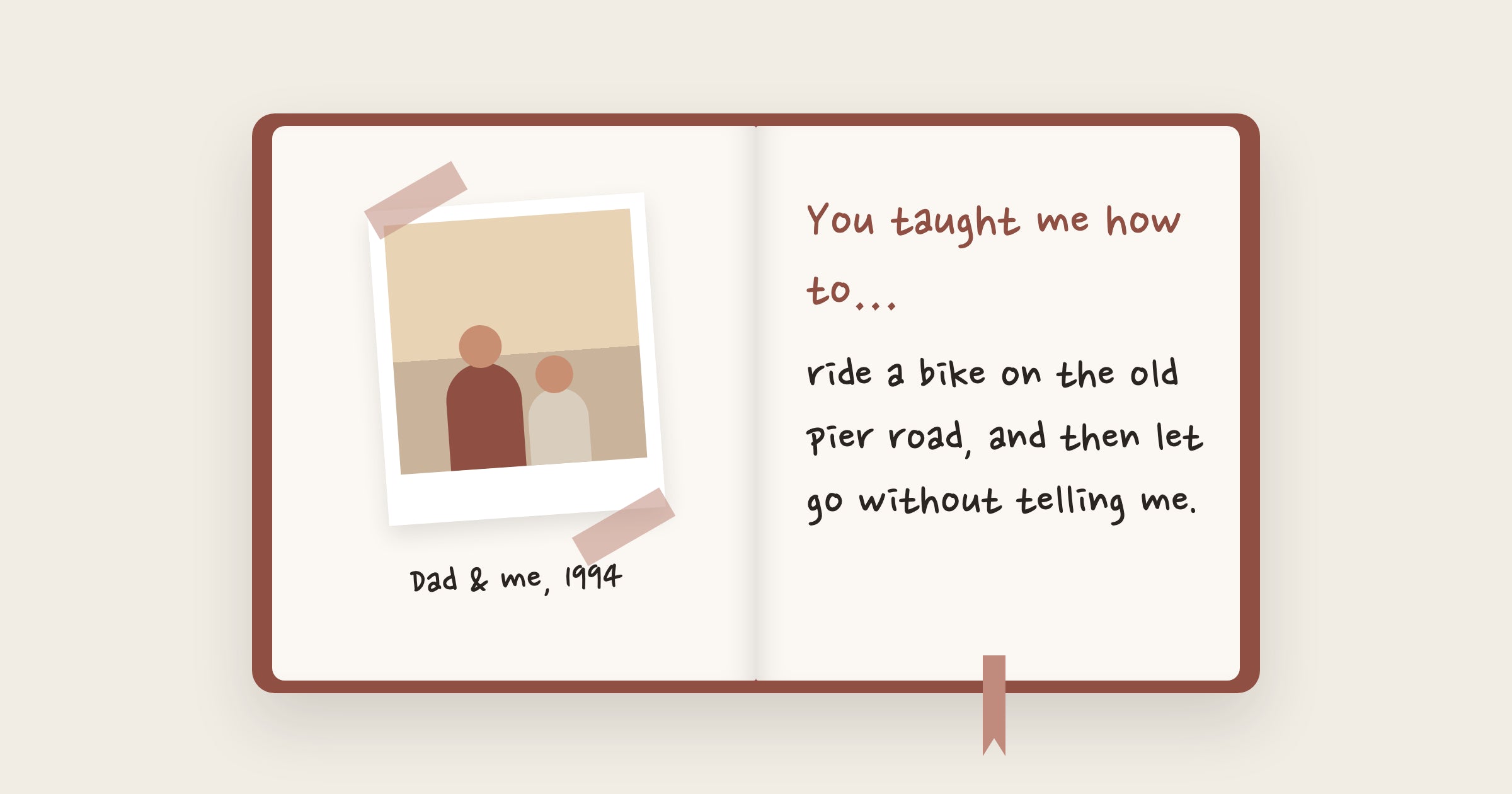
- You taught me how to…
- The best advice you ever gave me was…
- Something I didn't appreciate until I was older was…
- I still do ___ the way you showed me.
- When things went wrong, you always…
- Something I've passed on to my own children is…
Funny moments
- The time we laughed so hard we couldn't stop was…
- The most embarrassing thing you ever did in front of my friends was…
- The holiday where everything went wrong was…
- Your worst ever cooking disaster was…
- The thing you do that drives everyone mad (in the best way) is…
Places and traditions
- Every Christmas, we always…
- Sunday dinners at yours meant…
- The holiday I'd go back to tomorrow is…
- Our family tradition I'd never give up is…
- The walk, drive or journey I'll always associate with you is…
Who you are
- Three words that describe you are…
- The thing I most admire about you is…
- You're happiest when…
- Something most people don't know about you is…
- I knew you were proud of me when…
- I'm most like you when…
Thank you
- I don't think I ever thanked you for…
- The time you were there when I really needed you was…
- What I hope you know is…
- If I could relive one day with you, it would be…
Prompts for a memory book they fill in
If the book is for your mum, dad or grandparent to write in, these questions get their own story down in their own words.
- Where were you born, and what was the house like?
- What did a normal Saturday look like when you were ten?
- Who was your best friend growing up?
- What was your first job, and what did it pay?
- How did you meet Mum (or Dad)?
- What was the world like when you were twenty?
- What are you proudest of?
- What do you remember about the day your first child was born?
- What's the best advice you were ever given?
- What would you like your grandchildren to know about you?
For sixty more, see our list of questions to ask your parents. Some people find it easier to talk than to write. If that's your mum or dad, try recording the conversation instead and writing it up afterwards.
A memory book for grandparents
Grandparents' memory books are lovely when the grandchildren are involved. Ask each child to add a page: a drawing, a photo of them together, or the answer to “My favourite thing about Grandma is…”. Older grandchildren can interview their grandparents and write up the answers. The questions children ask are often the ones adults are too polite to.
Memory books and dementia
Memory books are also widely used to support people living with dementia, as a way to prompt conversation and recognition. If that's why you're making one, keep it simple: one large photo per page, a short caption in big clear writing (“This is our wedding day, Brighton, 1968”), and names written out in full. Alzheimer's charities offer free guidance on making life story books, and they're worth a look.
A few final tips
- Don't wait for it to be perfect. A finished book with wobbly handwriting beats a beautiful one that never gets made.
- Date everything. Future readers will thank you.
- Read it together. The best part of giving a memory book is the hour afterwards, when it comes out that you've got one story slightly wrong and you get the real version instead.